



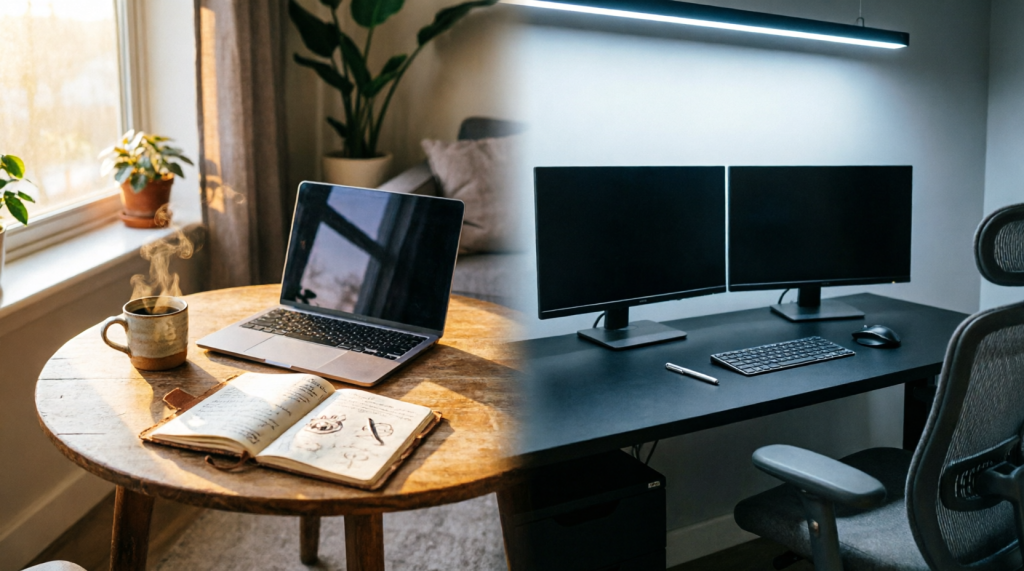
You want to work from home, a café, or a beach. Good news: both freelancing and full-time remote work let you do that. But they feel very different in daily life. One gives you a steady paycheck. The other gives you more freedom, and more risk.
Let’s break it down in plain words so you can choose with confidence.
What’s the real difference?
A full-time remote job means you work for one company, usually from home. You get a monthly salary, and often benefits like paid leave and health cover. You still have a manager, a team, and set work hours.
A freelancer works for several clients and sells their skills project by project. You set your own prices and schedule. But you are also the boss, the accountant, and the sales team.
The trend is growing. 28% of freelancers work fully remotely, compared with only 5% of full-time employees, according to Upwork’s 2026 research. So freelancing is one of the easiest ways to be truly location-free.
Money: who earns more?
It depends on who you ask, and on how steady you need your income to be.
Skilled full-time employees earned slightly more on average in 2025 ($109,000 vs. $101,000), but their pay varied a lot more. The lowest-paid quarter of employees made $65,000, while the lowest-paid quarter of freelancers made $80,000. Also, 86% of freelancers said they were happy with their pay, versus 68% of full-time employees.
That looks great for freelancers, but there is a catch. A freelance paycheck is not guaranteed, and many costs come out of your own pocket. One comparison estimates that freelancers pay their own health insurance, equipment, and self-employment tax (15.3% in the US), and lose 20–30% of their working hours to unpaid admin.
Simple rule: don’t compare salary to rate. Compare your take-home pay after costs and unpaid time.
Stability and security
This is where full-time remote work wins.
- You get paid on the same day every month.
- You often have paid leave, sick days, and sometimes a pension plan.
- If things go badly, you usually get a notice period.
As a freelancer, a client can leave overnight. If you are sick or on holiday, you earn nothing. Many freelancers handle this by saving a few months of expenses and never relying on one client.
Freedom and flexibility
Here, freelancing is the clear winner. You choose your clients, your projects, your hours, and sometimes even your country.
But full-time remote work is not rigid either. In a FlexJobs survey, 58% said fully remote is their ideal way to work, and 30% said nothing would make them go back to the office full time. Many remote employees enjoy great flexibility, especially in companies that trust their people.
Working from anywhere sounds great, but should you do it with a boss or on your own?
Work-life balance: not as easy as it sounds
Both paths have a hidden trap: overwork.
In Buffer’s remote work survey, 81% of remote workers said they check work email outside work hours, and 22% said not being able to switch off was their biggest challenge. Freelancers face the same problem, plus the pressure to always look for the next client.
Loneliness is another issue. The same survey found that 33% of people felt they stayed home too often with no reason to go out. Research on Microsoft’s remote teams also showed that collaboration between different groups dropped by about 25%, which makes it harder to learn from others.
Tip: whichever path you choose, plan real breaks, set clear work hours, and see people in person from time to time. A coworking space or a weekly coffee with a friend can help a lot.
Career growth
In a full-time job, the path is clearer: mentors, training, promotions, and a team to learn from.
As a freelancer, you grow faster in some ways. You meet many industries and learn to sell, negotiate, and manage projects. But nobody hands you a promotion. You have to build your own path.
Can you do both?
Yes, and many people do. About 46% of people who freelance also work full-time elsewhere. A side project lets you test freelancing, build a client list, and keep your safety net.
Quick checklist: which path fits you?
Full-time remote may be better for you if:
- You want a stable income and benefits.
- You like working in a team and having clear goals.
- You prefer a clear career ladder.
- Uncertainty stresses you out.
Freelancing may be better for you if:
- You have in-demand skills and some savings.
- You enjoy choosing your projects and clients.
- You can manage money, taxes, and sales on your own.
- You can handle quiet months without panic.
How to decide (and how to start)
- Write down your monthly costs. Know the minimum you need to earn.
- Test before you leap. Take one or two small freelance projects while you still have your job.
- Build a safety net. Aim for 3 to 6 months of expenses in savings.
- Ask yourself honestly: do I want freedom more, or peace of mind more?
There is no perfect answer. Full-time remote work gives you security and structure. Freelancing gives you freedom and a higher ceiling, with more risk. The right choice depends on your skills, your money situation, and your personality.
The good news? Your choice is not permanent. Many people start in one path and move to the other. Pick the one that fits you today, and adjust as you grow.
References
- Upwork. Freelancing Stats 2026: Market Size, Earnings, and Future Trends. https://www.upwork.com/resources/freelancing-stats
- FlexJobs. 30% of Workers Say Nothing Would Convince Them to Return to Office Full Time: Remote Work Statistics 2026. https://www.flexjobs.com/blog/post/flexjobs-remote-work-statistics-report
- iHire. The Freelance Revolution: Insights Into the 2026 U.S. Workforce. https://www.ihire.com/resourcecenter/employer/pages/the-freelance-revolution-insights-into-the-2026-us-workforce
- Buffer. 2023 State of Remote Work. https://buffer.com/state-of-remote-work/2023
- Buffer. Some Remote Workers Struggle with Leaving Home: Here’s How We Handle It at Buffer. https://buffer.com/resources/feeling-lonely-remote-work/
- SHRM. Does Remote Work Hurt Productivity? https://www.shrm.org/topics-tools/news/hr-magazine/does-remote-work-hurt-productivity
- Work In Anywhere. Freelancing vs Full-Time Remote (2026): Real Income & Lifestyle Comparison. https://workinanywhere.com/blog/freelance-vs-fulltime-remote-2026