



Ask ten managers where their team works best, and you will get ten strong opinions. Some swear by the office. Others say they will never go back. But what does the research actually show?
Let’s skip the hype and look at the evidence.
Why this debate won’t go away
Since 2020, the way we work has changed a lot. Many companies now want people back at their desks. Many employees want to keep their flexibility.
Microsoft’s Work Trend Index found a gap between the two sides. In its 2022 report, 82% of business leaders said getting people back to the office was a concern. Yet 73% of employees said they needed a better reason to go in than “the company expects it.”
That gap is why the question matters. Let’s look at each model.
Full remote: high engagement, but not for everyone
Fully remote work gives people freedom, no commute and more control over their day. The numbers on engagement are strong.
In Gallup’s 2025 State of the Global Workplace report, 31% of fully remote employees were engaged at work. For hybrid workers it was 23%. For on-site workers in jobs that could be done remotely, it was also 23%.
But there is a catch. The same report shows fully remote workers were less likely to say they were thriving in life (36%) than hybrid workers (42%). Isolation is real. Without a good routine, remote work can feel lonely.
Best for: self-driven people, global teams, and roles that rely on focused, independent work.
Hybrid: the middle ground that works
Hybrid is the most popular setup, and it has the best evidence behind it.
The strongest proof comes from a study at Trip.com, a large travel company. Researchers ran a randomized trial with 1,612 employees. Some worked from home two days a week, and the others stayed in the office full time. The study ran for six months, and the results were published in Nature in 2024.
The results were clear:
- Quit rates dropped by about one-third for hybrid workers.
- Performance reviews did not get worse.
- Promotion rates did not suffer.
In other words, people were happier and stayed longer, with no loss in output. Stanford economist Nick Bloom, one of the study’s authors, called hybrid a “win-win-win” for productivity, performance and retention.
Gallup’s data points the same way. Remote-capable employees prefer hybrid by a wide margin, about six in ten. Hybrid workers also report better work-life balance and less burnout than people who are fully on-site.
Best for: most knowledge workers, and teams that want flexibility without losing human contact.
Full office: good for some work, but not a magic fix
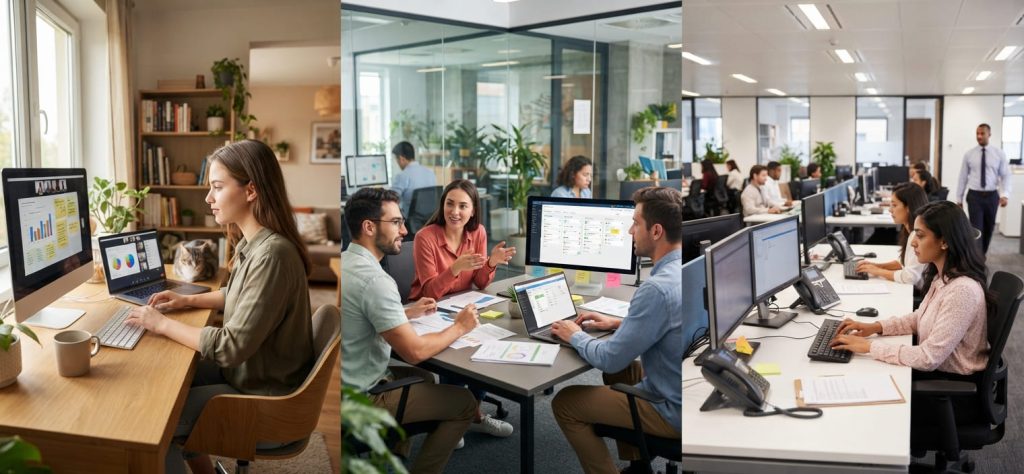
Being together in person has real benefits. It helps with training new hires, quick brainstorming and building trust, especially in new teams.
But the data does not show that forcing everyone in five days a week makes people more productive. Gallup finds that on-site workers in remote-capable jobs are often less engaged than their hybrid and remote peers. Microsoft calls the leader worry behind many office mandates “productivity paranoia.” That is the fear that people aren’t working just because you can’t see them.
Some jobs also have no choice. If you work in a lab, a shop or a factory, you have to be there. The key is to do it well, with a clear purpose for being together.
Best for: hands-on roles, new teams, and companies that need constant in-person work.
What really drives productivity? Management
Here is the part most debates miss. Where people work matters less than how the team is managed.
Gallup’s research says management quality and team coordination play a big role in hybrid productivity. The best hybrid teams do a few simple things:
- They pick on-site days with a clear purpose, such as workshops, planning or team-building.
- They train managers to lead teams that are not always together.
- They check in with people often, not just once a month.
- They set clear goals, so results matter more than hours online.
A messy hybrid policy can hurt a team. A well-organized one can help it.
A quick comparison
| Full Remote | Hybrid | Full Office | |
| Engagement (Gallup 2025) | Highest (31%) | Medium (23%) | Lower for remote-capable roles (23%) |
| Flexibility | Very high | High | Low |
| Team connection | Needs effort | Balanced | Easiest |
| Retention | Good | Strong evidence of improvement | Risk if people want flexibility |
| Main risk | Isolation | Poor coordination | Lower engagement, burnout |
Everyone has an opinion on where we should work. Few people have checked the data. Here is what it really says.
A fair warning about the research
No single study settles this. The Trip.com trial is excellent, but it covered one company and mostly engineers, marketers and finance staff. Engagement is also not the same thing as output. The right answer depends on your industry, your team and your goals.
One more fact helps keep the debate in perspective. According to Stanford’s WFH Research survey, work from home has settled at around 25% of paid workdays in the US. That is roughly three times the pre-2020 level. It has stayed steady for years, so it looks like a lasting change, not a trend.
So, which one wins?
If you want a simple answer, hybrid has the strongest proof for most office-based teams. It keeps people productive, helps them stay longer and gives them flexibility without losing contact.
But the best choice is the one that fits your work. Test it, ask your team, track real results, and adjust. And whatever model you pick, invest in good managers. They make the biggest difference.
References
- Bloom, N., Han, R., & Liang, J. (2024). Hybrid working from home improves retention without damaging performance. Nature, 630, 920–925. https://www.nature.com/articles/s41586-024-07500-2
- Gallup. State of the Global Workplace 2025. https://www.gallup.com/workplace/349484/state-of-the-global-workplace.aspx
- Gallup. Hybrid Work and Productivity: What the Data Show. https://www.gallup.com/workplace/713093/hybrid-work-productivity.aspx
- Gallup. Global Indicator: Hybrid Work. https://www.gallup.com/401384/indicator-hybrid-work.aspx
- Microsoft WorkLab. Great Expectations: Making Hybrid Work Work (2022 Work Trend Index). https://www.microsoft.com/en-us/worklab/work-trend-index/great-expectations-making-hybrid-work-work
- WFH Research (Stanford / Survey of Working Arrangements and Attitudes). Research and Policy. https://wfhresearch.com/research-and-policy/